
The right AI adoption strategy prioritizes business outcomes over technology, starts with an honest maturity assessment, and picks pilots by scoring value against feasibility and data readiness. Before you write a single line of code or sign a vendor contract, you need three things locked down: a clear strategic mandate, a realistic read on your data and governance posture, and an actual roadmap with milestones. Everything below builds toward that checklist.
TL;DR:
- Conduct an honest AI maturity assessment across strategy, data, governance, technology, and culture to identify capability gaps and inform the development plan.
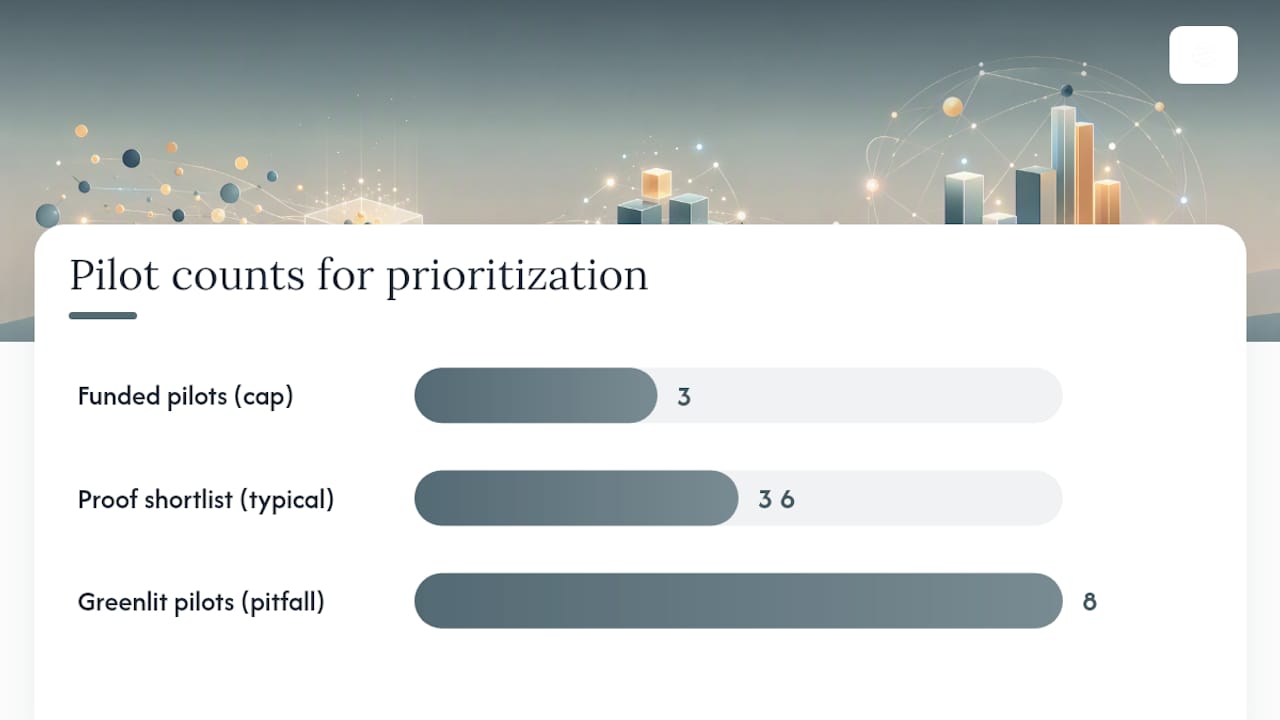
- Prioritize AI use cases based on a scoring matrix that evaluates potential value, feasibility, data readiness, and risk, limiting initial projects to three to avoid partial experiments.
- Ensure data quality, accessibility, and continuous monitoring for model drift before platform evaluation and model deployment to prevent timeline delays and degraded performance.
- Embed governance practices, including model inventory, risk classification, approval gates, and monitoring, into the development process from day one to prevent costly rework.
- Focus on leadership commitment, building an AI operating model with clear roles, training, and incentives, because organizational culture and support are critical for successful adoption.
Table of Contents
- What Is Your AI Adoption Maturity, and Why Assess It First?
- How Do You Prioritize AI Use Cases Against Business Goals?
- What Data and Technology Foundations Does AI Adoption Require?
- How Do You Embed Governance and Responsible AI From Day One?
- How Do You Manage the People Side of AI Adoption?
- What Does a Practical AI Implementation Roadmap Look Like?
- How Do You Measure AI Adoption Success?
- Why Do AI Adoption Projects Fail, and How Do You Prevent It?
- Our Take on What Actually Moves the Needle
- Ready to Build Your AI Roadmap?
- Sources
- FAQ
What Is Your AI Adoption Maturity, and Why Assess It First?
Most organizations overestimate their readiness because they confuse pilot enthusiasm with operational capability. An honest assessment fixes that before it costs you a budget cycle.
A mature strategy measures capability across five staged levels, not just whether a chatbot works in a demo. The common progression runs from Foundational (experiments, no strategy) through Emerging, Operational, Scaled, to Transformational, where AI is embedded in core decision making. Gartner's AI maturity framework scores organizations across pillars like strategy, data, governance, technology, and culture, while CMU's Software Engineering Institute built a companion model with eight to twenty dimensions depending on scope, designed to produce a repeatable, evidence-based roadmap rather than a one-off audit. MITRE's model takes a workforce and mission angle, scoring ethical use, strategy, organization, tech enablers, data, and performance separately, which matters if your bottleneck is culture rather than infrastructure.
Run the assessment with a small, cross-functional group, not a single department:
- Include a business sponsor, a data or IT lead, a compliance or legal voice, and someone from the frontline team that would actually use the output.
- Collect evidence, not opinions: existing data pipelines, current model experiments, past pilot outcomes, and staff skill inventories.
- Score each pillar on a simple 1 to 5 scale and flag where scores diverge most sharply between departments.
- Translate the gaps into a one to three year plan: shore up foundational gaps in year one, scale proven use cases in year two, optimize and expand in year three.
Pro Tip: Run the assessment twice, six months apart, using the same scoring rubric. The delta between the two runs tells you more about whether your program is actually moving than the absolute score ever will.
How Do You Prioritize AI Use Cases Against Business Goals?
Every AI program eventually collides with the same question: which use case gets funded first? The answer should come from a scoring matrix, not the loudest department.
Score every candidate use case across four dimensions: potential value, technical feasibility, data readiness, and risk exposure. A use case with high value but poor data readiness needs a data remediation phase before it deserves funding. One with high feasibility but low value is a distraction dressed up as quick a win. Microsoft's Cloud Adoption Framework for AI recommends anchoring this scoring to specific business objectives from the outset, confirming data accessibility for each target scenario, and validating that the required skills exist internally before you shop for a solution.
A practical sequence looks like this:
- List every candidate use case proposed across departments, no matter how small.
- Score each on the four-part matrix using the same rubric leadership agreed on during the maturity assessment.
- Set a proof-of-value gate for the top three to five candidates, typically a short window with a defined success metric.
- Fund the portfolio, not the project. Treat AI investment as an ongoing strategic allocation, with a small reserve for the pilots that clear their gate and need scaling capital.
- Kill or pause anything that misses its gate, and redirect that budget rather than letting a stalled pilot linger.
Common early winners tend to be internal productivity tools (document summarization, code assistance) and customer-facing automation with bounded scope (support triage, personalized recommendations), both of which need shorter proof windows than anything touching regulated decisions like credit or hiring.
Pro Tip: Cap your first funding round at three use cases. Organizations that greenlight eight pilots simultaneously almost always end up with eight half-finished experiments and no clear signal on any of them.
What Data and Technology Foundations Does AI Adoption Require?
Choosing a model before checking your data is like ordering furniture before measuring the room. The technology decision is the easy part; the data work is where timelines actually slip.
Before you evaluate a single platform, run through the readiness checklist:
- Confirm you can actually access the data a use case needs, not just that it exists somewhere in a warehouse.
- Audit data quality: missing fields, inconsistent formats, and duplicate records will quietly degrade any model built on top of them.
- Check labeling and metadata for anything that needs supervised training or retrieval grounding.
- Build for what one Forbes analysis calls "context hydration": a continuous feed of operational knowledge and business rules into the model, because without it, outputs drift stale fast.
On the platform side, think in trade-offs, not brand names. Hosted foundation models get you to a working prototype in days but limit customization and raise data residency questions. Managed platforms trade some flexibility for built-in monitoring, access controls, and compliance tooling, which matters once you move past a proof of concept. Custom models cost more upfront and take longer, but they fit tightly regulated workflows or highly specific domain logic that generic tools handle poorly.
Whatever you choose, build drift monitoring into the operational plan from day one. Models degrade as real-world data shifts away from training assumptions, and a quarterly retraining schedule paired with automated performance alerts catches that decay before customers or regulators do.
Pro Tip: Ask any vendor how they detect model drift in production, not just how accurate their model is at launch. The answer separates a serious operational partner from a demo.
How Do You Embed Governance and Responsible AI From Day One?
Bolting governance onto an AI program after launch is the single most expensive mistake we see, because rework and reputational damage cost far more than building it in from the start.
A working governance structure needs a few concrete building blocks:
- A model inventory. Every deployed model, its owner, its purpose, and its last review date, tracked in one place.
- Risk classification. Not every model needs the same scrutiny. A model recommending blog topics carries different stakes than one screening loan applications.
- Approval gates. Define who signs off before a model moves from pilot to production, and what evidence they need to see.
- Monitoring and incident response. A plan for what happens when a model produces a harmful or biased output, including who gets notified and how fast.
Responsible AI practices belong in the production design itself, not in a policy document nobody reads. That means bias checks on training data and outputs, explainability requirements proportional to the decision's stakes, and access controls that limit who can query sensitive models. Microsoft's framework treats responsible AI as a parallel workstream running alongside use case development, not a final checkpoint. Governance gates should map directly to your deployment stages: no model clears the scaling phase without passing its risk review, and no KPI dashboard goes to leadership without a corresponding governance status line.
How Do You Manage the People Side of AI Adoption?
Technology rarely kills an AI program. People do, usually through quiet resistance, skills gaps, or leadership that funds a pilot and then disappears.
Start with an operating model. Most organizations that scale successfully build some version of an AI office or center of excellence that sets standards, alongside domain champions embedded in business units who translate those standards into local context, and product owners accountable for specific use cases end to end.
- Form pilot squads that pair a technical lead with a business owner and at least one frontline user, so the people who will actually use the tool shape it from week one.
- Design a rollout program that phases access by team, gathers feedback at each phase, and adjusts before wider release.
- Build training pathways matched to role, not a single generic course; a data analyst and a sales rep need entirely different AI literacy.
- Set incentive structures that reward adoption and honest feedback about what isn't working, not just usage volume.
Leadership commitment and culture do more heavy lifting here than any technical decision. IMD's research on enterprise AI execution identifies leadership, culture, capital, talent, and brand as the five organizational levers that determine whether a strategy actually lands, and success depends on leaders committing capital and attention before the technology has fully proven itself, not after. A funded pilot with no executive sponsor tends to stall the moment the original champion changes jobs.
Pro Tip: Ask your pilot squad one question at the 30 day mark: "What would make you stop using this tomorrow?" The honest answers surface adoption risks faster than any satisfaction survey.
What Does a Practical AI Implementation Roadmap Look Like?
A roadmap without dates and decision gates is a wish list. Structure yours in four stages, each with a defined exit condition before you move to the next.
- Pilot (weeks 1 to 12). Validate the top scored use cases against their proof-of-value gates. Success looks like a measurable outcome tied to the business objective, not just technical functionality. Exit gate: the metric hits its target and the governance review clears.
- Operationalize (months 3 to 6). Harden the pilot for production: build monitoring, define incident response, integrate with existing systems rather than running as a standalone tool. Exit gate: the model runs unattended for a defined period without manual intervention exceeding an agreed threshold.
- Scale (months 6 to 12). Extend to additional teams or geographies, formalize training pathways, and connect the use case's KPIs to the executive dashboard. Exit gate: adoption rate and performance hold steady as the user base grows.
- Optimize (ongoing). Retrain models against fresh data, retire underperforming use cases, and reinvest freed capital into the next portfolio round.
Cross-functional rollout works best when IT integration happens in parallel with the operationalize stage, not after. Waiting until scale to connect a model to your CRM or ERP system almost always adds months you didn't budget for.
How Do You Measure AI Adoption Success?
Track two categories of metrics, and report them together, or your dashboard will tell only half the story.
Outcome KPIs answer whether the business is actually better off: revenue lift, cost reduction, customer satisfaction shifts, or cycle-time improvements tied directly to the use case's original business objective. Operational KPIs answer whether the system is healthy: model accuracy over time, usage rates by team, latency, and error frequency.
- Track adoption rate weekly during the pilot phase; a stalling adoption curve is the earliest warning sign of a failing rollout.
- Monitor data pipeline stability continuously; unstable feeds upstream will show up as accuracy drops downstream weeks later.
- Report to executives monthly during pilot and scale stages, quarterly once a use case reaches the optimize stage.
- Keep the executive dashboard to one page: three outcome metrics, three operational metrics, and a governance status indicator.
Statistic to watch: organizations that treat AI funding as a strategic portfolio rather than a single procurement tend to sustain longer feedback loops, which gives proof-of-value gates room to actually work instead of being rushed for a quarterly report.
Why Do AI Adoption Projects Fail, and How Do You Prevent It?
Most failures trace back to a handful of repeat offenders, and each has a specific fix.
- Mismatched expectations. Leadership expects transformation from a narrow pilot. Fix: tie every use case to a specific, bounded metric from the start.
- Talent gaps. No one internally understands how to evaluate model output. Fix: pair internal hires with short-term specialist partnerships during the first scaling wave.
- Poor data foundations. Fix: run the readiness checklist before any procurement conversation, not during it.
- Governance vacuum. Fix: stand up the model inventory and approval gate before the first production deployment, not after an incident forces it.
Treat a stalled pilot, a missed proof-of-value gate, or a governance review that keeps getting postponed as red flags that should trigger a pause and re-scope, not a reason to push harder on the same plan. SEI's research on adoption failures points to exactly this pattern: organizational and data gaps, not technology limits, sink most programs.
Our Take on What Actually Moves the Needle
Most AI adoption strategy advice treats maturity assessment as a formality before the "real work" of picking tools. We treat it as the real work. An honest assessment of where data, governance, and culture actually stand determines which use cases survive contact with production, and skipping it is why so many pilots die quietly in month four. Our approach builds engagements around that sequence: assess, prioritize with evidence, then implement with governance in place rather than bolted on later. You can see the research methodology behind that approach, or read more about how Merkium works across financing, marketing, consulting, and logistics use cases.
— afonso
Ready to Build Your AI Roadmap?
If you've read this far, you already know the hard part isn't picking a model, it's knowing which use case deserves your budget first and what governance needs to exist before you launch it. Merkium runs assessment-driven engagements that pair a maturity review with a bespoke implementation roadmap, so you leave with a prioritized use-case list and a governance structure already scoped, not just a slide deck.

This approach leans on research-backed methodology rather than a generic playbook and spans multiple sectors, so the roadmap reflects sector-specific constraints rather than a template built for a different industry. Responsible AI practices, including risk classification and monitoring, get built into the plan from the first assessment, not added after a pilot goes sideways. If you want a clear-eyed read on your organization's actual maturity level and a roadmap you can hand to your leadership team next quarter, start with Merkium's research and assessment services and request a scoped conversation about your priorities.
Sources
For deeper detail on the frameworks referenced throughout this piece: Gartner's AI maturity model and roadmap toolkit, Microsoft's Cloud Adoption Framework AI strategy guidance, CMU SEI's AI Adoption Maturity Model, MITRE's AI maturity model, and IMD's analysis of the levers that drive AI strategy execution.
- Gartner AI Maturity Model and AI Roadmap Toolkit | Gartner
- AI strategy - Guidance to set your organization's AI strategy
- AI Adoption Maturity Model: Improving How Organizations Adopt AI Solutions | CMU SEI
- Ai maturity model | MITRE
- Enterprise AI strategy execution: The levers that matter - I by IMD
FAQ
What Is the 30% Rule in AI?
There's no single agreed-upon "30% rule" in AI adoption literature; the phrase gets used loosely to describe the common finding that roughly a third of a project's effort should go toward change management and adoption rather than pure model building. Treat it as a directional reminder, not a fixed formula.
What Is the Failure Rate of AI Adoption Projects?
Failure rates vary widely by industry and definition of "failure," but SEI's research consistently identifies mismatched expectations, weak data foundations, and talent gaps as the dominant causes, not the underlying technology itself.
What Is the 10/20/70 Rule for AI?
It's a useful gut check for budgeting, though exact splits differ by organization and use case.
Which Country Leads in AI Adoption?
Leadership varies by measure (research output, enterprise deployment, government investment) and shifts year to year, so no single country holds an uncontested lead across every metric. What separates leading organizations, regardless of country, is consistent investment across the five levers IMD identifies: leadership, culture, capital, talent, and brand.
How Do You Choose Between Building a Custom Model and Using a Hosted Platform?
Match the choice to your data sensitivity and use case complexity: hosted models suit fast prototypes with lower customization needs, while custom models fit regulated or highly domain-specific workflows where generic tools fall short.