
Data privacy for AI means controlling what personal information a model absorbs, retains, and can be made to reveal, at every stage from training to deployment. Three actions matter most right now: test whether your data or model outputs can be traced back to real people, apply strict data minimization before anything reaches a training pipeline, and run a documented risk assessment before shipping. Regulators including the EDPB and the frameworks under the EU AI Act do not accept blanket anonymity claims. They expect a case-by-case evaluation, backed by evidence.
TL;DR:
- Regular testing is essential to determine if AI outputs can be traced back to individuals, as regulators require case-by-case proof rather than blanket anonymity claims.
- Data minimization should be enforced before training, and detailed risk assessments must be documented to identify potential privacy leak points during deployment.
- Privacy risks mainly arise from extraction, prompt leakage, bias inference, and supply chain vulnerabilities, which can be mitigated with targeted prompt testing and strong access controls.
- High-risk AI applications like healthcare, finance, and biometric systems face stricter regulatory scrutiny, including conformity assessments and outright bans on certain biometric scraping practices.
- Ongoing governance, including continuous monitoring, re-evaluation, and clear ownership, is critical to maintaining effective privacy protections throughout an AI system's lifecycle.
Table of Contents
- What Is AI Data Privacy, and Why Does It Differ From Traditional Privacy?
- What Privacy Risks Do AI Systems Actually Introduce?
- What Do Regulators Actually Require for AI Privacy?
- When Do You Need a DPIA for an AI System?
- What Technical Mitigations Actually Reduce AI Privacy Risk?
- How Should Governance Work Across the AI Lifecycle?
- Where Is AI Privacy Risk Highest?
- What's a Practical Compliance Checklist for AI Privacy?
- How Merkium Turns Privacy Guidance Into Working Programs
- What Should Organizations Prioritize First?
- How Merkium Supports Privacy-Safe AI Deployment
- Sources
- FAQ
What Is AI Data Privacy, and Why Does It Differ From Traditional Privacy?
Traditional data privacy protects records: a name in a spreadsheet, a customer ID in a database, an email address in a CRM. You can locate that record, delete it, or redact it. AI data privacy protects something harder to pin down: information that has been absorbed into model parameters, embedded in a vector store, or generated as an output that indirectly reveals a training example.
That distinction changes everything about remediation. You cannot simply "delete" a person's data from a trained neural network the way you'd delete a row from a database. Once information shapes the weights of a model, removing it usually means retraining, not editing.
AI systems create privacy exposure at several distinct points:
- Training data collection, where personal information enters a dataset, often scraped or licensed at scale.
- Fine-tuning, where a base model is adapted using narrower, sometimes more sensitive, organizational data.
- Inference, where a live query can prompt a model to reconstruct or leak memorized details.
- Retrieval-augmented generation (RAG), where a model pulls from a connected knowledge base in real time.
- Feedback loops, where user interactions get logged and potentially reused for further training.
The EDPB's opinion on AI models makes the underlying problem explicit: a model can be "anonymous" for GDPR purposes only after testing whether training data can be extracted and whether outputs relate back to that data. That's a technical test, not a legal formality, and it's one most organizations haven't run.
What Privacy Risks Do AI Systems Actually Introduce?
Most AI privacy failures fall into a short list of recurring patterns. Here's how they tend to show up in practice:
- Collection and consent mismatches. Data gathered for one purpose (support tickets, sales calls) gets repurposed to train a model, without the original consent covering that use.
- Purpose creep. A model built for internal analytics quietly becomes the backbone of a customer-facing feature, with no fresh assessment of the new exposure.
- Extraction and membership inference. Attackers, or just curious users, craft prompts designed to pull memorized training examples out of a model. Research has documented cases where large language models reveal personally identifiable information trained into them, confirmed by a review of AI privacy violation and protection.
- Prompt-based leakage. Sensitive context fed into a prompt during one session surfaces in an unrelated session, especially in poorly isolated multi-tenant deployments.
- Bias-based inferential harm. A model infers sensitive attributes, health status, sexual orientation, likely income, from proxy signals never explicitly collected, then acts on that inference.
- RAG and knowledge-base leaks. A retrieval system connected to internal documents surfaces confidential records to users who shouldn't see them.
- Agentic access escalation. An AI agent with permissions to call other systems can chain access in ways no single system owner anticipated.
- Insider and supply-chain risk. Third-party model providers, annotation vendors, or contractors handling training data introduce exposure outside your direct control.
Pro Tip: Run a "red-team prompt" exercise before launch: have someone actively try to extract training examples or bypass your RAG permissions. If they succeed in an afternoon, a motivated attacker will too.
What Do Regulators Actually Require for AI Privacy?
The regulatory picture splits into three layers, and each one imposes a different kind of obligation.
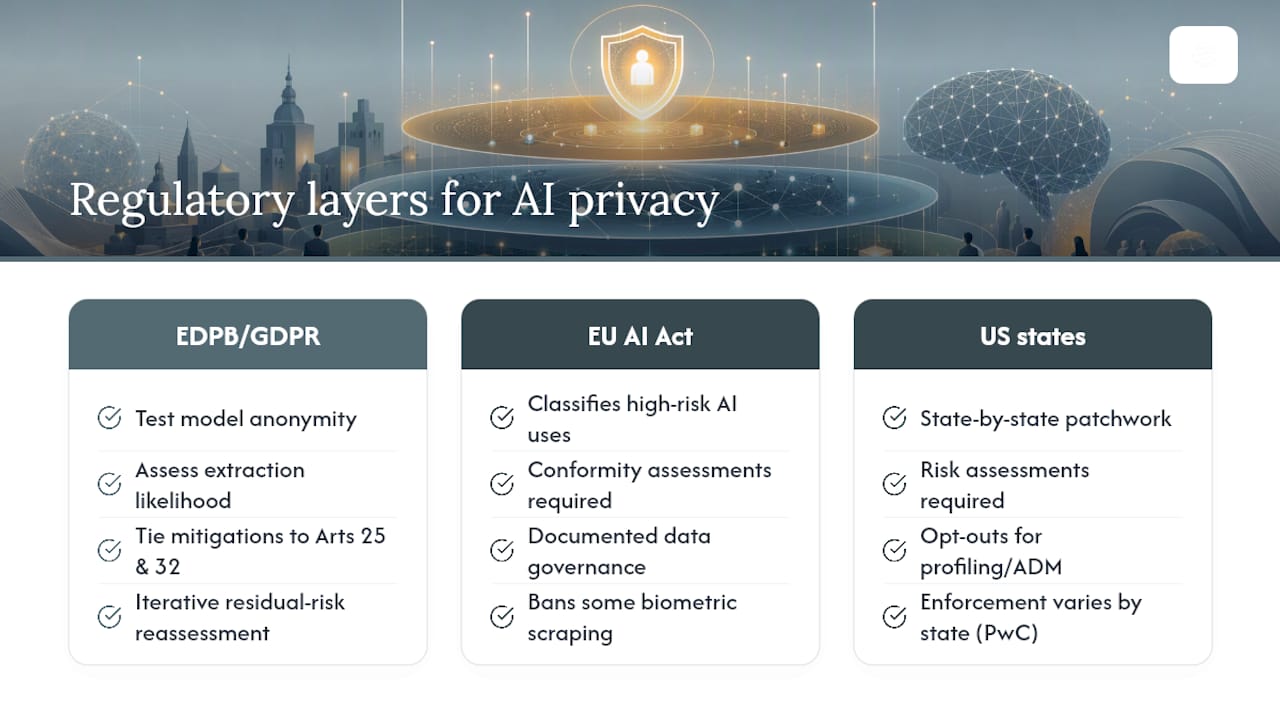
The EDPB set the tone with its opinion establishing that model anonymity has to be tested, not assumed. Regulators look at the likelihood of extracting training data and the likelihood that outputs relate back to specific individuals, evaluated against "all means reasonably likely to be used." The EDPB's separate LLM-specific guidance goes further, laying out a risk-management methodology that ties privacy mitigations directly to GDPR Articles 25 (data protection by design) and 32 (security of processing), and it calls for iterative reassessment of residual risk rather than a one-time sign-off.
The EU AI Act adds a second layer on top of GDPR. It classifies certain AI uses as high-risk, biometric categorization, employment screening, credit scoring among them, and imposes conformity assessments and documented data governance for those systems. The regulation itself also bans some biometric scraping practices outright, regardless of consent.
GDPR's core mechanics still apply underneath both: organizations need a lawful basis for training data, a defined purpose that doesn't silently expand, and minimization that limits what enters a pipeline in the first place. The ICO's guidance on individual rights in AI systems flags a genuine structural problem here: honoring access or erasure requests is far harder when a model was trained on third-party or scraped data with no clean record of provenance.
In the United States, there's no single federal AI privacy law. Instead, a state-by-state patchwork is filling the gap. Laws under the CPRA in California, plus Colorado's and Virginia's privacy statutes, now require risk assessments and opt-out mechanisms specifically for profiling and automated decision-making, with PwC's analysis of state AI privacy rules noting that enforcement and penalty structures vary meaningfully by state.
When Do You Need a DPIA for an AI System?
A Data Protection Impact Assessment isn't optional paperwork for most AI deployments, it's a trigger-based requirement, and the triggers come up more often than teams expect: large-scale processing of personal data, systematic profiling, use of sensitive categories (health, biometric, financial), or any system that produces automated decisions with legal or significant effects on individuals.
A workable DPIA for an AI system needs to document:
- A full data inventory, covering training sets, fine-tuning data, and any data pulled into a RAG pipeline.
- Processing records that map each data flow to its specific legal basis and stated purpose.
- Extraction and identifiability test results, meaning actual red-team probes against the model, not a theoretical assessment.
- Residual risk conclusions, stated plainly, with the mitigations applied and what risk remains after them.
- Monitoring and incident procedures specifically for model-output leakage, separate from your standard data breach playbook.
That last point matters because a leak from a model isn't like a leaked file. It can happen one query at a time, invisibly, with no obvious breach event to trigger your existing incident response. Logging prompts and outputs, with retention limits that match your privacy policy rather than convenience, gives you the forensic trail you'll need if something surfaces later.
What Technical Mitigations Actually Reduce AI Privacy Risk?
No single technique solves this. Privacy-enhancing technologies (PETs) reduce exposure, but each comes with a real trade-off that engineering teams need to plan for, not discover after deployment.
- Differential privacy adds calibrated noise to training data or model updates so individual records can't be reverse-engineered. The tuning parameter, epsilon, controls the trade-off directly: lower epsilon means stronger privacy and weaker model accuracy, so it needs deliberate evaluation, not a default setting.
- Federated learning trains models across decentralized devices or servers without centralizing raw data, which limits collection but adds real orchestration and infrastructure complexity.
- Synthetic data can stand in for sensitive real records during development, but it doesn't automatically fix bias or fidelity issues. A synthetic dataset generated from a biased source often just launders the same bias into a "clean" format.
- Access controls, encryption, and secure enclaves limit who and what can touch raw data during training and inference.
- RAG safeguards and prompt filtering restrict what a retrieval system can surface and screen outputs before they reach a user.
The EDPB's LLM-specific guidance frames these tools clearly: PETs are mitigations that reduce risk, not replacements for governance. A differentially private model with no DPIA and no monitoring is still an unmanaged risk, just a quieter one.
Pro Tip: Before committing to differential privacy at scale, pilot it on a subset of your data and measure the actual accuracy drop. Teams that skip this step often discover the utility cost only after the model is already in production.
How Should Governance Work Across the AI Lifecycle?
Privacy protections decay if nobody owns them past launch day. Effective governance treats privacy as a lifecycle discipline, not a pre-launch checkbox.
- Design and collection stage. Build privacy-by-design into annotation guidelines and data collection specs before a single training run starts, not as a retrofit.
- Retention and minimization stage. Tie retention schedules to the specific purpose each dataset serves, and delete or archive data once that purpose expires.
- Vendor and access stage. Contract terms with model providers and annotation vendors need explicit data-handling clauses, paired with access controls that log who touched what.
- Ongoing re-evaluation stage. Anonymity claims have a shelf life. As re-identification techniques improve, a model considered safe last year may not be safe today, which is exactly the concern the EDPB raised about reassessing anonymity over time.
Where Is AI Privacy Risk Highest?
Not every deployment carries the same stakes. A few categories consistently draw the most regulatory and reputational scrutiny:
- Healthcare AI handling diagnostic or patient data almost always lands in high-risk categorization under the AI Act.
- Financial AI used for credit scoring or fraud detection faces similar treatment, plus sector-specific rules on automated decisions.
- Biometric systems, facial recognition or voice ID especially, sit under some of the AI Act's outright prohibitions when used for scraping or mass surveillance.
- AI agents that connect to third-party systems multiply exposure vectors fast. Every additional system an agent can touch is another place personal data can leak or be misused.
- Internal versus public-facing models need genuinely different control levels. An internal tool used by trained staff can tolerate lighter guardrails than a public chatbot exposed to anyone with a browser.
What's a Practical Compliance Checklist for AI Privacy?
Teams that get this right tend to work in three horizons rather than trying to fix everything at once.
- Immediate: build a data inventory, map every dataset to a specific purpose, and apply stop-gap minimization, stripping unnecessary fields, before any further training happens.
- Medium-term: run a full DPIA, pilot at least one PET against real data, and update vendor contracts and user-facing privacy notices to reflect actual AI processing.
- Ongoing: monitor deployed models continuously, re-test outputs for leakage as attack techniques evolve, and report findings to stakeholders on a fixed cadence rather than only after an incident.
Pro Tip: Assign one named owner to the "ongoing" column. Checklists that stop at deployment fail quietly, months later, when nobody's job description includes re-testing a model that shipped safely a year ago.
How Merkium Turns Privacy Guidance Into Working Programs
Guidance documents describe what good looks like. Building it is a different job, one that requires research capacity and engineering discipline working together. Merkium's approach to AI research centers on exactly that gap: translating regulatory expectations into risk inventories, DPIA artifacts, and PET pilots that hold up under scrutiny, not just on paper.
In practice, that work tends to include:
- Data flow mapping and extraction testing for models already in production.
- Structured DPIA documentation aligned to the risk categories regulators actually check.
- Piloting differential privacy or synthetic data against a client's real accuracy requirements before committing to a rollout.
- Ongoing model monitoring built into deployment, not bolted on afterward.
That mirrors Merkium's broader approach to AI safety: treat privacy as a continuous engineering problem, not a compliance memo.
What Should Organizations Prioritize First?
The mistake I see most often isn't a missing PET or an outdated privacy notice. It's treating anonymization as a fact rather than a claim that expires. Ongoing monitoring of identifiability and model outputs matters more than any single technique you bolt on at launch. Prioritize documented DPIAs and governance over a one-time anonymization sign-off, and put real budget behind PET pilots and vendor controls before a regulator or a researcher forces the issue.
— afonso
How Merkium Supports Privacy-Safe AI Deployment
If the checklist above looks straightforward on paper but daunting to execute with a small internal team, that gap is exactly where a research-driven partner earns its keep. Some providers work with organizations building financing, marketing, consulting, and logistics models to convert privacy requirements into working systems, not just documentation.
That means research grounded in the same regulatory frameworks covered here, model development that treats data minimization as a design constraint from day one, and safety practices built to survive a regulator's actual questions, not just an internal audit. Merkium's model deployment capabilities cover the engineering side of this work: access controls, monitoring, and the kind of iterative testing that a one-time anonymization claim can't replace. If you're evaluating whether your current AI systems could withstand a DPIA today, that's a reasonable place to start a conversation with Merkium's research team about a pilot.
Sources
- EDPB opinion on AI models — GDPR principles to support responsible AI
- Regulation (EU) 2024/1689 (AI Act)
- How do we ensure individual rights in our AI systems? — ICO guidance
FAQ
Does AI Keep Your Data Private?
Not automatically. Whether an AI system protects your data depends on how it was trained, what safeguards were applied, and whether the provider has tested for extraction risk, something regulators like the EDPB require rather than assume.
What Is the 30% Rule in AI?
If you've seen this term used, treat it with caution, as it doesn't correspond to any recognized framework from bodies like the EDPB, ICO, or the EU AI Act.
What Did Bill Gates Warn About AI?
Public commentary from technology leaders, Bill Gates included, has raised general concerns about AI's pace of development and its societal risks, but this article focuses specifically on data privacy compliance rather than broader AI safety commentary, so a detailed attribution isn't covered here.
Will ChatGPT Leak My Data?
Any large language model carries some risk of memorizing and later surfacing fragments of training or conversation data, which is precisely why extraction testing and prompt-leakage safeguards matter. Providers vary in how they handle retention and reuse of chat data, so check the specific service's data policy rather than assuming uniform protection across tools.
What's the Difference Between Data Minimization and a DPIA?
Data minimization is a practice, collecting and retaining only what a specific purpose requires. A DPIA is an assessment process that tests whether a given AI system's processing, including its minimization choices, creates unacceptable privacy risk before or during deployment.